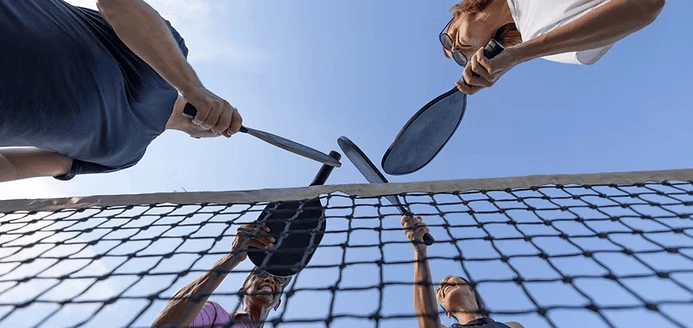
The Kitchen, in Short
The kitchen is the 2.13m strip of court either side of the net, sideline to sideline, formally called the non-volley zone. One rule governs it: no player may volley the ball while standing in the zone or touching its line. Players may enter the kitchen freely at any other time, including to play a ball that has bounced. A serve that lands in the kitchen, or on its line, is a fault.
That is the entire rule. Almost every dispute about the kitchen comes from a misunderstanding of what it does not prohibit.
Where the Kitchen Is
| Boundary | Detail |
|---|---|
| Depth | 2.13m (7 ft) from the net on each side |
| Width | The full 6.10m between the sidelines |
| The line | The non-volley zone line belongs to the zone |
| Beyond the sidelines | Not part of the zone - the kitchen ends at the sideline |
That last row surprises experienced players. A player standing off the court, outside the sideline extension and level with the net, is not in the non-volley zone and may legally volley from there.
The One Rule
A volley is any ball struck out of the air, before it bounces. It is a fault to volley when:
- Either foot is inside the non-volley zone.
- Either foot is touching the non-volley zone line.
- Anything a player is wearing or carrying is touching the zone - a dropped paddle, a cap that falls, a towel.
The fault is called on the volley, not on the position. Standing in the kitchen is never itself an offence.
Legal or Fault
| Situation | Verdict |
|---|---|
| Standing in the kitchen, hitting a ball that bounced | Legal |
| Standing in the kitchen, volleying | Fault |
| Volleying with one foot on the kitchen line | Fault |
| Jumping from behind the line, volleying mid-air, landing behind the line | Legal |
| Jumping from behind the line, volleying mid-air, landing in the kitchen | Fault |
| The ball bounces in the kitchen during a rally | Legal |
| A serve lands in the kitchen or on its line | Fault |
| Paddle swings over the kitchen while feet stay behind the line | Legal |
| Touching a partner who is standing in the kitchen while volleying | Fault |
Momentum
If a player volleys and their own momentum then carries them into the non-volley zone, it is a fault - even if the ball has already bounced twice on the other side, and even if the point is otherwise clearly won.
The rally does not end when the ball dies. It ends when the volleying player has come to rest outside the zone. A player who lunges forward for a high volley, wins the point outright, and then stumbles onto the line has lost that point.
The same applies to anything the player is holding. A paddle released mid-follow-through that lands in the kitchen is a fault by momentum.
Re-establishing Position
A player who has been in the kitchen may volley again once both feet have contacted the court outside the zone. Dragging one foot back is not enough; the rule requires the player to be fully re-established.
In practice, this is why coaches teach a small backward hop after retrieving a short ball from inside the kitchen. Recover before the next ball arrives, not during it.
The Serve and the Kitchen
The serve must clear the non-volley zone entirely. A serve landing inside the zone is out. A serve landing on the non-volley zone line is also out - the only line in pickleball that does not count as in.
Every other line is fair. A serve catching the baseline, the sideline or the centreline of the correct service court is good, however narrowly.
Edge Cases Worth Knowing
- Partner contact. If a volleying player touches their partner while that partner is standing in the kitchen, the fault carries. Contact with something touching the zone is contact with the zone.
- Clothing and equipment. Anything the player wears or carries counts as part of them.
- Reaching over the net. Following through over the net after striking the ball on your own side is legal, provided nothing touches the net, the posts or the opponent's court.
- The ball that spins back. If a ball bounces on your side and spins back over the net, you may reach across to play it, again without touching the net.
Why the Kitchen Exists
Without it, the sport would be decided by height and reach. Two tall players at the net could stand on top of the tape and volley every ball downward, and rallies would end in one shot.
The zone pushes both sides back to a fixed line and forces a softer game. The dink - a controlled shot dropped into the opponent's kitchen - exists because of it. So does the third shot drop, the patient reset that lets the serving side advance to the line after the two-bounce rule has run its course.
Playing the Kitchen Well
- Take the line. In doubles, the strongest position is both partners standing a few centimetres behind the kitchen line, paddles up.
- Let it bounce. A ball that would land in the kitchen is not a ball to volley. Step in, take it off the bounce, step back out.
- Dink cross-court. The diagonal is the longest path over the lowest part of the net.
- Move as a pair. If one partner is pulled wide, the other slides across. Gaps at the kitchen line are where points are lost.
Three Drills
- Dink for five minutes. Two players, both at the kitchen line, no volleys, no winners. Count consecutive dinks and beat the number.
- Bounce and reset. A partner feeds short balls into the kitchen. Step in, hit off the bounce, re-establish both feet behind the line before the next feed.
- The momentum test. Volley high balls from just behind the line and hold the finish. If a foot moves forward, the shot was taken too late.
Where to Practise
The soft game rewards court time more than instruction. The club's flagship at i-City Central Mall, Shah Alam is taking reservations now, with regulation pickleball lines arriving at the Kelana Jaya and Paradigm Mall PJ venues; both sit alongside a full library of guides in resources.
For the wider ruleset, see pickleball rules explained. For the score call, see traditional and rally scoring.
FAQ
What is the kitchen in pickleball?
The kitchen is the non-volley zone: a 2.13m strip of court on each side of the net, running the full width between the sidelines. No player may volley the ball while standing in it or touching its line.
Can you step into the kitchen in pickleball?
Yes, at any time. Standing in the kitchen is legal. Only volleying from it, or being carried into it by the momentum of a volley, is a fault.
Can you hit the ball in the kitchen if it bounces?
Yes. Once the ball has bounced, a player may play it from inside the kitchen without restriction. The rule targets volleys only.
Is it a fault if the ball lands in the kitchen?
No, except on the serve. During a rally the ball may land anywhere inside the court, including the kitchen. A serve landing in the kitchen or on its line is a fault.
What happens if your momentum carries you into the kitchen?
The point is lost. The fault applies even when the ball is already dead and the rally appears won, because the volley is not complete until the player has come to rest outside the zone.
Can you jump over the kitchen to volley?
Yes, provided both take-off and landing are outside the zone. Volleying mid-air above the kitchen is legal; landing in it is a fault.